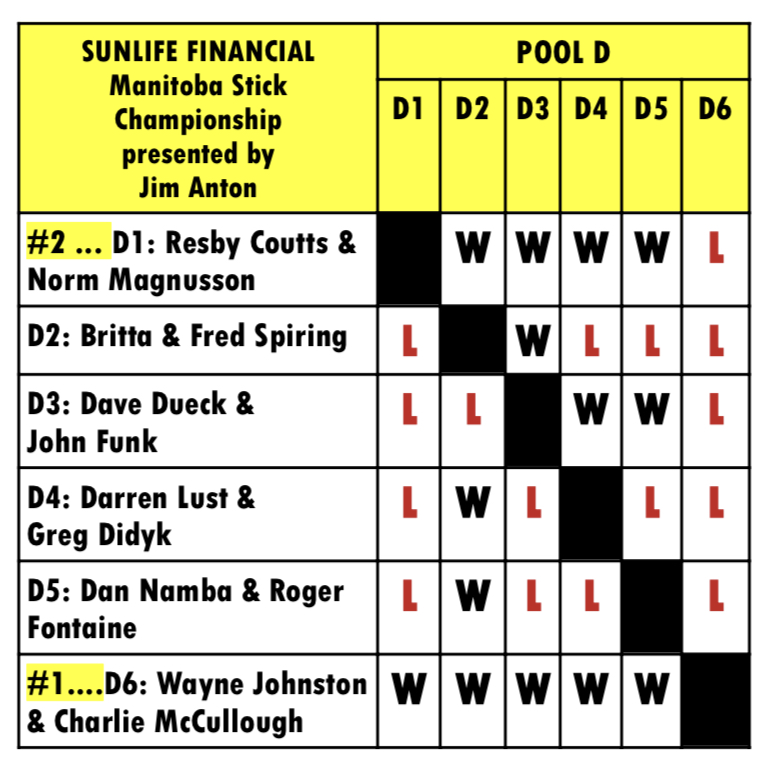
Quite a few years ago, my 2-person stick curling partner, Norm Magnusson and I decided that we should take up the 2-person game. We hadn’t yet quit playing on a 4-man team and we were still getting our competition from playing at the Seniors and Masters levels.
However, we knew the time was coming when we might not be able to throw with the accuracy that we wanted to, so we decided to dabble in the stick-curling world. At first, it was in our regular leagues. Gradually, however, we started taking in a few of the growing number of 2-person stick bonspiels around the province.
As we began to have a bit of success in those bonspiels, I learned two important things. First, I learned that the joy of competition is just as real at the age of 65-70 as it was at the age of 25-30. The two-person stick game provided the competitive opportunity that I hadn’t really had for about a decade.
Second, I learned that I had to re-learn one of the basics of curling that I had learned as a child – how to get a proper rotation on the stone at the point of release.
I discovered pretty quickly that the same issues I had struggled with for many years were still there: the in-turn being turned across and inside the target, the elbow flared out on the out-turn and therefore outside the target. Plus, I quickly discovered that the extra 4-5 feet of stick exaggerated those problems.
So began my quest to improve my release – on target with a good rotation.
I was quickly reminded that one of the secrets of success is practice and more practice. I tested pretty well all of the available versions of the delivery stick and I learned that every one of them worked OK if you focussed on a clean release with the same hand/wrist action to get good rotation as I’d been using for years when throwing. The more practice, the more consistency.
The practice paid off by gradually getting me to the point where I improved from 2 to at least 3 (sometimes 3 1/2) rotations. It also paid off with a Canadian championship crest which Norm and I still proudly display on a jacket.
The next challenge, of course, was to increase the number of rotations to be consistently over 3, knowing that the stone will run straighter down the ice with the greater number of rotations.
That’s when I was given the opportunity to test the original version of Asham’s TruRelease Delivery Stick. This prototype was straight from Terry Gibb’s workshop. Like Santa’s little helper, Terry said he had been working on a design which he believed would allow greater accuracy of release and which would create a higher rate of rotation.
Easy to suggest these were nothing more than promotional claims for a new product – until I tried it. Just by throwing a few stones one day, I was sold on the concept. As soon as the factory-made version was available this season, I started using the TruRelease and I am even more convinced now.
Both the added accuracy and the extra rotation are functions of the unique design. I don’t claim to understand the physics but, in some way, it relates to three key design aspects:
- The design’s push-point is at the point where the handle curls down to the rock, not at the end of the handle which is the most common stick design, resulting in the turn being initiated at the centre of the stone;
- The design’s ‘cradle’ fits under the handle, not over the top of the handle which is the most common stick design, and
- The design’s pivot-point is about an inch above the handle of the stone which, when push is applied, seems to create a small amount of leverage which transfers back along the handle creating a gentle lift or pressure to maximize contact between the cradle and the stone handle.
The other point that Terry made when he was explaining the design to me was that I no longer had to think about putting the rotation on the stone. He said he guaranteed that if I started the stone with the traditional 2 o’clock or 10 o’clock set and if I gave the stone a straight push to the broom, it would come off the delivery stick with as many as 4 1/2 – 5 rotations.
It works! I am getting those extra rotations most of the time without any hand/wrist/arm action to create the rotation.
Is it also more accurate as claimed? That is tougher to prove but the simple fact is it has to be! Assuming you are lined up properly on the target in your set-up, and assuming you move on that required straight line to the target, the release has to be more on-target than it used to be when problems resulted from the actual movement required to create the rotation.
Is it perfect? No. You’ll note I said ‘most of the time’ above. Simply put, it is human nature to want to blame the technology, not the operator, when the technology fails. However, when those extra rotations don’t happen, I accept that it was probably a fault in my release.
I referred at the top to my quest to improve my release. I don’t suggest that I have achieved perfection – probably never will. However, I don’t hesitate to suggest that, for me, the TruRelease Delivery Stick has got me a few steps closer.
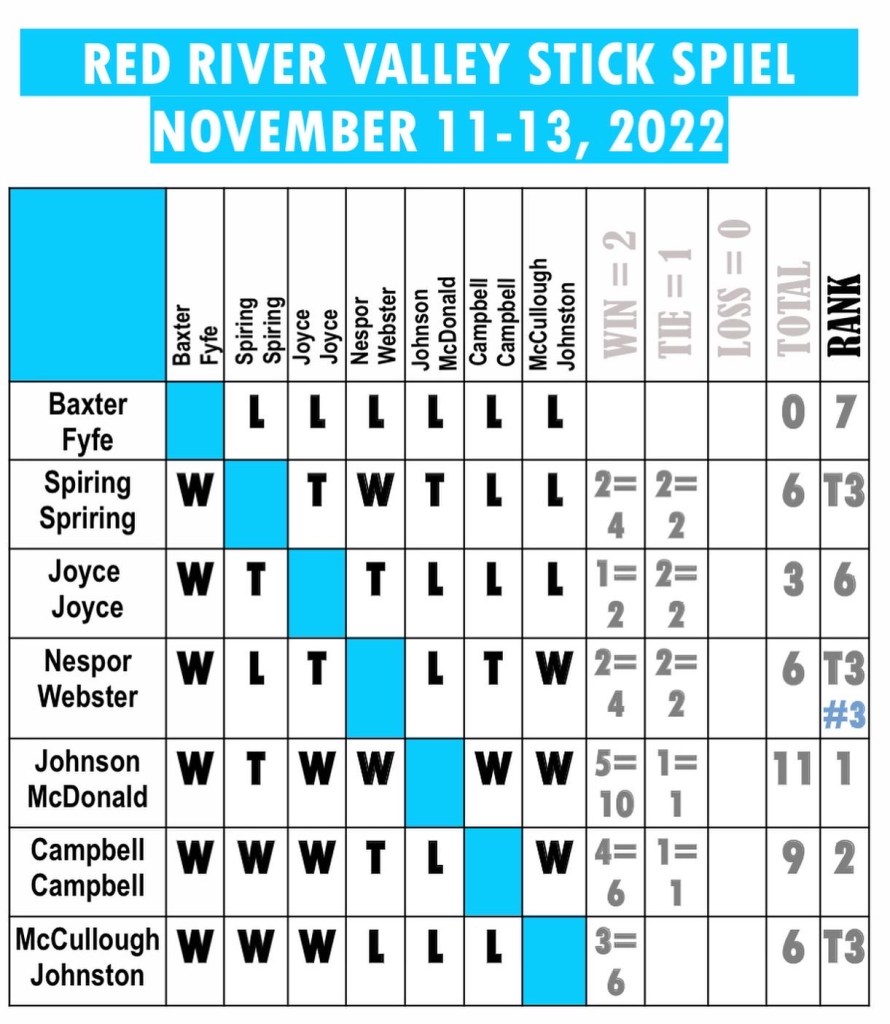
However, it doesn’t mean it will allow me to win a Manitoba championship or another Canadian championship or even the next bonspiel. The trouble is, other people now using the TruRelease, like current Canadian champions Warren Johnson and Dan McDonald, are also improving their ability to get the desired number of rotations and that more consistently on-target release.
The competition continues. It is why we play the game!














 thecurler.com